

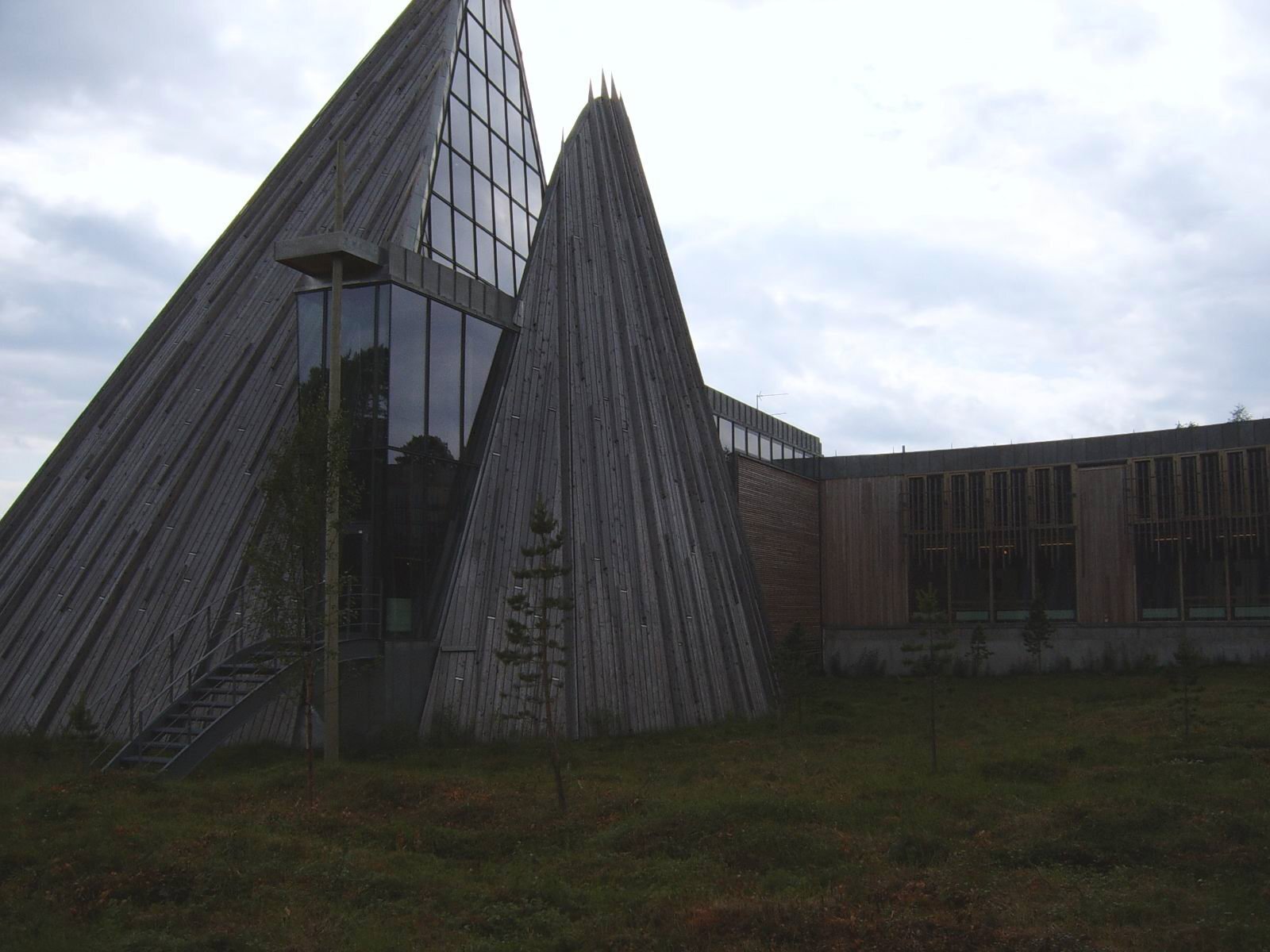
Photos: Vberger (brightened by Ranveig) (Public domain) · Wikimedia Commons
Sámi Parliament – Karasjok
About
The Sámi Parliament (Sámediggi) in Karasjok is the elected assembly of the Sámi in Norway. Its building opened in autumn 2000: the plenary hall is inspired by the lávvu, the tent of the reindeer-herding families, and the offices curve around it in a semicircle – Nordic architecture with Sámi traditions.
Local knowledge: from protests to a parliament. The Sámi Parliament exists partly because of a conflict over a river in Finnmark. In the late 1970s and early 1980s, plans for a hydroelectric power plant on the Alta–Kautokeino river led to large protests by Sámi activists and environmentalists, and the conflict became a turning point in the struggle for Sámi rights in Norway. The power plant was built, but the protests brought national attention to Sámi culture, land rights and political representation. In 1989 King Olav V opened the first Sámi Parliament; the building you see today followed in 2000.
How it works: unlike the national parliament in Oslo, the Sámi Parliament represents an Indigenous people, not everyone living in one region – it speaks for Sámi people throughout Norway, not only in Finnmark. Its 39 representatives are elected from seven constituencies across the country every four years, on the same day as the national parliamentary election. To vote you must be on the Sámi Parliament’s electoral roll: you identify as Sámi, and you, a parent, grandparent or great-grandparent has had Sámi as a home language – or a parent is or was on the roll.
The Sámi Parliament works to protect and develop the Sámi languages, culture, education and cultural heritage, and Norwegian authorities must consult it on decisions that may affect Sámi interests. It does not make laws like the national parliament, but it manages certain funding programmes and administrative tasks. So when you visit, you are not just looking at an unusual building – you are visiting an institution born from generations of effort to protect Sámi language, culture and rights.
Visiting (2026): free guided tours, no booking needed, on Tuesdays, Wednesdays and Thursdays at 13:00; from 22 June to 14 August 2026 at other times. The building is closed at weekends, and there are no tours in committee and plenary weeks (in 2026 e.g. 16–20 November and 30 November–4 December). Groups contact samediggi@samediggi.no.
Tips for campers: an easy cultural stop on the road between Alta, Kautokeino, Karasjok and Finland – there is a car park by the building. Check the tour times before you arrive. Good to know on the way: the Alta Canyon, where the Alta controversy led to the creation of this parliament.

Weather & Northern Lights
Now
In 24 hours
Northern Lights Chances
Weather forecast from MET Norway (yr.no). An indication, not a promise: aurora activity over this place (NOAA) times the clear sky in the best three-hour window of the night (MET Norway). The next nights rest on the Kp forecast only. More: our Northern Lights Forecast and the Northern Lights Map.
Getting there
Sámediggi, Ávjovárgeaidnu 50, 9730 Karasjok, Norway
Nearby
- Extra KarasjokNearest shop · 700 m
- Circle K KarasjokFuel600 m
- Toilets400 m
- Kárášjohka - KarasjokNearest town600 m
- Vinmonopolet LakselvNearest Vinmonopolet · 67 km
- Camping TenorinneNearest campsite16 km
Data from OpenStreetMap (ODbL)
On the way
Road reports within 40 km and the nearest road cameras, from Statens vegvesen (NLOD). The pictures refresh every few minutes; the reports are put into English word by word. All road cameras
Reviews
Rate this place
You are, or have been here? Give it your stars.
Comments
Thank you! Your comment is shown once we have read it.
No comments yet.
Write a comment
Let us know your experience with this place -- did something change? Your comment is shown once we have read it.
Please write a few words.
Thank you -- that is enough for now. Please try again in an hour.