

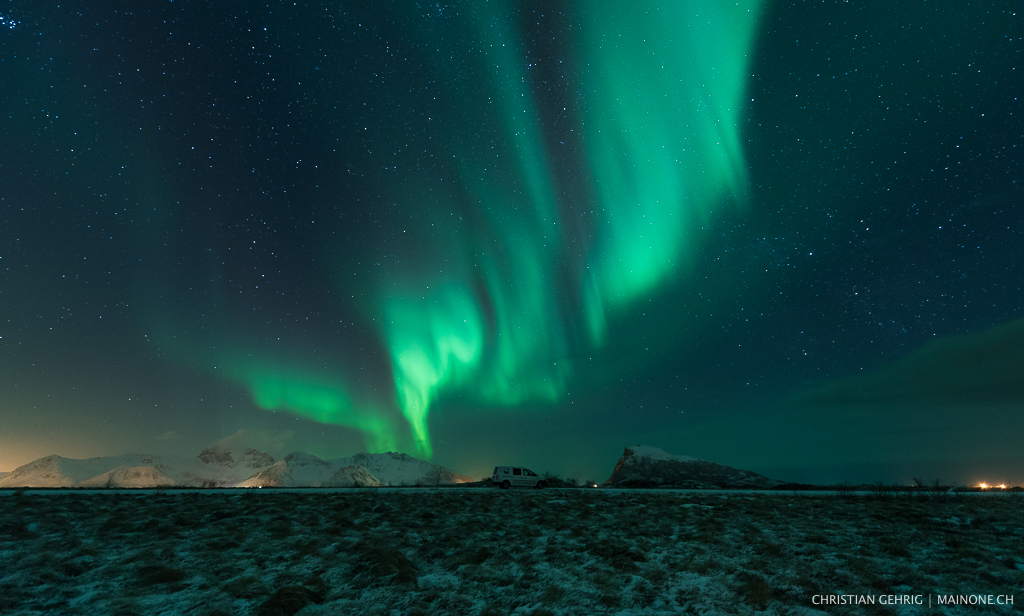
Everyone who comes north in winter asks the same question: where do I go tonight? Most answers are vague, because most forecasts tell you one thing for one town. After more than ten years of handing over campers to aurora chasers in Tromsø and Lofoten, and a good few nights out ourselves, we have turned the question into a method. It has three parts, and since this autumn our camper guide does the arithmetic for you, for every place on its map.
Three things have to come together
The northern lights are visible when three conditions are met at the same time, at the same place: there is aurora activity over your head, the sky is dark, and the sky is clear. Miss one and you see nothing, however strong the other two are. The trick is that only one of the three is in your hands, and that is the one a camper van is made for.
Activity: what the solar wind tells you
The aurora is caused by particles from the sun hitting the upper atmosphere, guided by the earth's magnetic field into an oval around the pole. Northern Norway sits under that oval, which is why Tromsø, Senja, Lofoten and the North Cape are among the best places in the world for it. How far south the oval reaches depends on the activity, which NOAA measures in several ways: the Kp index, a 0 to 9 scale averaged over three hours; the solar wind's speed and the direction of its magnetic field, called Bz, measured by a satellite about an hour upstream of the earth; and the OVATION model, which draws the oval as it is right now.
For Northern Norway the bar is low. Kp 2 to 3 is already enough for a show, because the oval sits over the region on an ordinary night. A southward Bz, written as a negative number, is the best short-term sign: it lets energy in, and the lights brighten within the hour. The three-day Kp forecast is good for planning which night, not which hour.
Darkness: the part nobody can change
The sun has to be more than six degrees below the horizon. From late August to mid April that happens every night in Northern Norway, and in December and January the sky stays dark for most of the day. Under the midnight sun, from late May to late July, no activity on earth will show you anything. So the season is the autumn, winter and early spring, and the dark hours of each night are the hours that count.
Clouds: the one you can do something about
The aurora happens a hundred kilometres up, far above the weather. An overcast sky hides it completely, and the coast of Northern Norway is not short of clouds. This is the condition that decides most nights, and it is also the only one you can beat. The weather is local: it can be overcast in one fjord and clear in the next, forty minutes away. The inland valleys towards Finland and Sweden are often clear when the coast is grey, and the opposite happens too. MET Norway forecasts the cloud cover hour by hour for every point in the country, and that forecast is the key to the whole method.
The map: all three in one place
We have joined the three conditions for every place in our Norway Camper Guide. Each spot on the map, more than 140 of them from Reine in Lofoten to the North Cape, carries its Northern Lights Chances: a percentage for tonight, tomorrow and the night after. The figure is the aurora activity over that place times the clear sky expected there, counted over the dark hours only, and we work it out for every three-hour window of the night and show the best one with its time. "Best 18:00 to 21:00, 78 %" means exactly that: go there, be outside at six, and the odds are on your side.
The Northern Lights Visibility Map shows all of them at once, each pin coloured by its chance, grey for low, amber for fair, green for good, with the number in the pin. Choose tonight, tomorrow or in two days. The ten best places for tonight are listed under the map, with the date and time of the computation. Everything is recomputed every 15 minutes from NOAA and MET Norway, and it is free, with no app and no account. For the big picture, our Northern Lights Forecast page shows the solar wind, the Kp index and the hemispheric power live, and the same chances for our best places in three-hour steps, side by side with the Kp forecast.
One honest word: the chances are a model built from public data, an indication and not a promise. A night with a 70 % spot and a 20 % spot is still a night you should spend at the 70 % spot.
Why a camper van is the other half of the method
Knowing where the sky is clear is worth nothing if you cannot get there and stay there. That is the whole point of a camper. A hotel fixes you to one town and one sky; a camper lets you move your bed to the fjord with the best number, arrive before dark, and wait in the warm with the heater running, a coffee on the stove and the sky in view through the window. If the lights come at two in the morning, you are already there. If the forecast changes during the evening, you drive forty minutes and try the next valley.
Winter roads above the Arctic Circle ask for the right vehicle, and ours are built for them. The Comfort Camper 4x4, a VW Transporter 4motion, and the Cabin Camper 4x4, a VW Crafter or MAN TGE 4motion, both have all-wheel drive and automatic gearboxes, studded winter tyres, a 4 kW diesel parking heater that runs with the engine off, and two extra batteries so the heater and your cameras last the night. Both are winter-ready from the first snow.
A night, step by step
- In the afternoon, open the Northern Lights Visibility Map and look at tonight. Note the three or four best places within a reasonable drive, and their best window.
- Check the Northern Lights Forecast for the Kp forecast and the solar wind. A negative Bz in the evening is your cue to be outside early.
- Drive to your first choice before dark, buy food on the way, and park with a free view to the north and away from street lights. Every place page in the guide shows the weather hour by hour, so you see if the clouds move in.
- Wait in the camper, lights off, and look out every ten or fifteen minutes. The aurora often starts as a pale grey arc or a faint band that looks like thin cloud. Point your phone camera at the sky: its sensor picks up the green long before your eyes do, so a quick photo in night mode tells you whether that grey is the aurora starting. Once it brightens, put the phone down and watch.
- If the sky closes in, check the map again and move. That is the whole advantage, so use it.
- When the show is over, sleep where you are. Norway's right to roam allows a night in a camper on most open ground, as long as you leave no trace.
When to come
The season runs from late August, when the nights get dark again, to mid April. September and October bring open roads, lakes that mirror the lights and milder temperatures; December and January bring the longest nights and the blue hour at midday; February and March bring more daylight for driving, snow on everything and the most settled weather of the winter. We are in a peak of the sun's eleven-year cycle, so the next winters are a good time for it.
Aurora forecast for Tromsø, Lofoten and Senja
The same method works for every region we cover. Around Tromsø the guide has its own spots on Kvaløya, at Sommarøy, in the Lyngen Alps and up the Skibotn valley towards Finland, where the sky is often clear when the coast is not. In Lofoten the beaches of Flakstad and Unstad and the fjords around Reine and Henningsvær face north over open water. Senja and Vesterålen sit in between. Each of them has a figure for tonight on the map, and the forecast page puts the best of them side by side.
If you have questions about a trip, write to us or ask at the handover. Many of us have worked as northern lights guides, and we are happy to look at the map with you.